The Richmond Blog
Fitness Tips, Nutrition Advice & Member Stories
Stay inspired and informed with the latest articles from our fitness experts and community.

Apr 20, 2025
Fitness Tips
Lower Back Pain From Sitting All Day: A Strength Fix for Desk Workers
If you work at a desk, your lower back has probably let you know about it: the mid-afternoon ache, the stiffness when you stand. Lower back pain in desk workers is rarely one dramatic injury. It is the slow cost of sitting still for hours. The good news is the body adapts fast to the right loading. Here is why sitting drives back pain, and how a movement screen and targeted corrective exercise fix it.
Why sitting all day hurts your back
Your spine is built to move, and a desk job removes almost all of that variety. Sitting shortens the hip flexors so they tug on the pelvis, and it switches off the glutes, the primary engine for hip extension. A weak, underactive backside forces your lower back to pick up the slack. Add a core that rarely works in a supported chair, and the spine ends up under-supported and overworked. Sitting also loads the lumbar discs more than standing does, especially when you slouch. Your back is not fragile, but a body shaped by sitting needs a counterbalance: strength.
Why strength is the fix, not just stretching
Stretching a sore back feels good but rarely fixes the cause, which is a lack of capacity in the muscles that support your spine. Exercise and progressive strengthening are among the most strongly supported interventions for managing and preventing recurrent lower back pain, and clinical guidelines now favour staying active over rest. For desk workers, the goal is to rebuild what sitting takes away: strong glutes, a bracing core, a posterior chain that hinges safely, and mobile hips and thoracic spine. Get those back and your lower back stops compensating. The only question is where to start, and that is what a movement screen answers.
The benefit of a movement screen
A movement screen assesses how well you perform fundamental patterns such as squatting, hinging, reaching and rotating. Rather than waiting for pain, it identifies restrictions, asymmetries and compensations early. For a desk worker, it quickly reveals the usual suspects from years of sitting: limited hip mobility, a stiff thoracic spine, poor glute activation, or a core that cannot stay stable, plus side-to-side asymmetries that often drive one-sided pain. The benefit is that it replaces guesswork with information and gives us an objective baseline to rescreen against, so you can see real progress. At The Richmond Gym we use a technology-assisted screen so results are measurable and repeatable, not a coach eyeballing you.
Turning the screen into corrective exercise
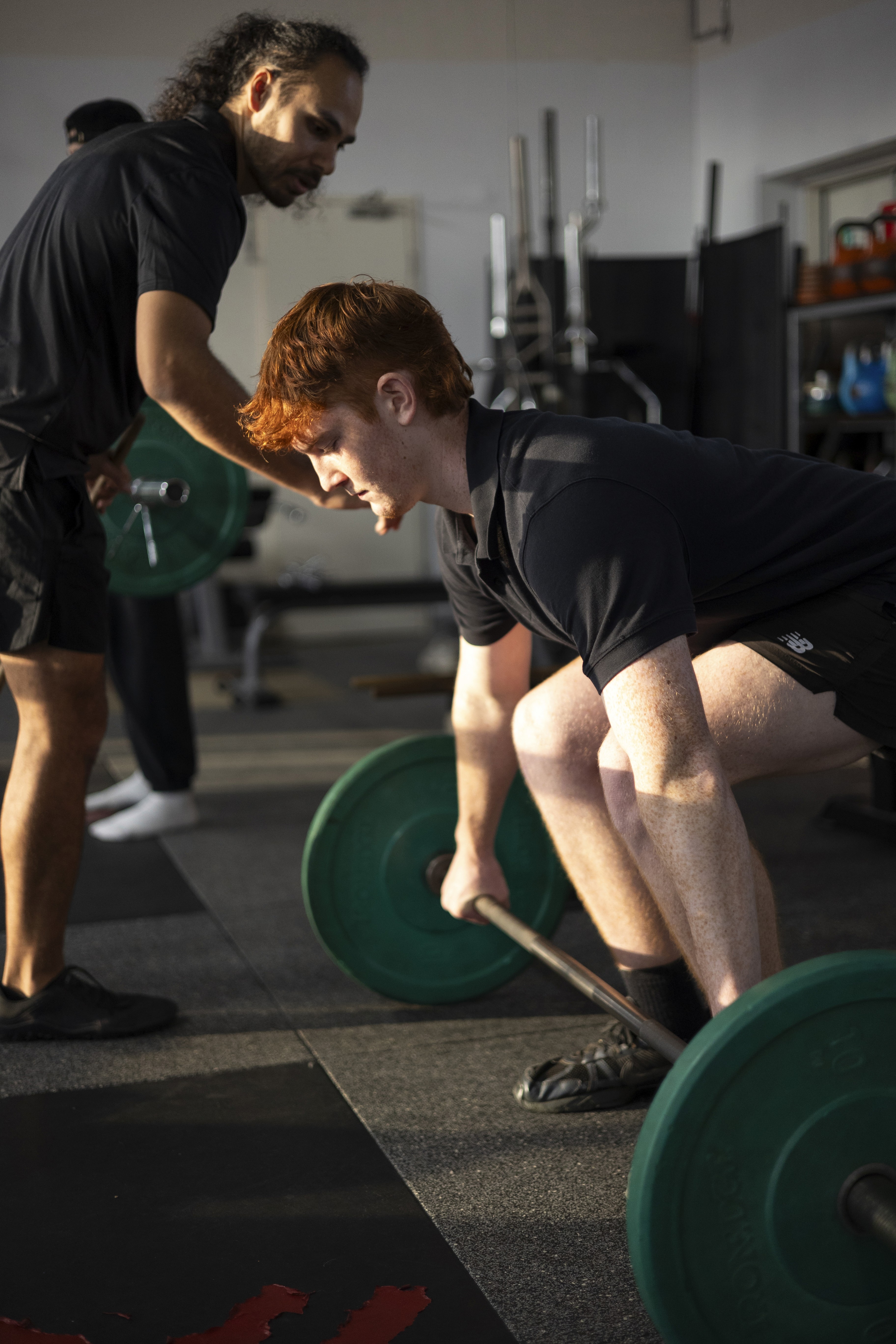
A screen only matters if it changes what you do next. Its purpose is to guide targeted corrective exercise aimed at your specific limitations, not a generic warm-up. The benefit is precision: underactive glutes get activation and hip-hinge work, stiff hips get targeted mobility reinforced under load, and an unstable core gets anti-extension and anti-rotation strength. Every drill has a reason. Corrective exercise is not endless rehab, though. It is the on-ramp to real strength training. Once a pattern is clean, we load it, so for a desk worker a solid hip hinge becomes a confident deadlift that makes everyday lifting easy. The process is simple and repeatable: screen, correct, load, reassess.
Small habits that help
Strength does the heavy lifting, but a few habits help alongside it: stand and move every thirty to sixty minutes, set your screen at eye level, and take movement snacks through the day, a few hip hinges or a short walk. These keep the tissues awake between training sessions.
Build a back that handles your desk job
Lower back pain from sitting is not something you have to live with. Our 3-Week Strength for Life program starts with a full movement screen, follows up with corrective exercise built around your results, then builds the strength that protects your back for the long term, all with coaching every step of the way.
Start the 3-Week Strength for Life Program and give your back the strength it has been missing.