The Richmond Blog
Fitness Tips, Nutrition Advice & Member Stories
Stay inspired and informed with the latest articles from our fitness experts and community.

Apr 20, 2025
Fitness Tips
Returning to the Gym at 50: How to Start Again Without Getting Injured
If it's been years since you last trained seriously, walking back into a gym can feel intimidating. The weights feel heavier than you remember, the machines have changed, and there's a quiet worry sitting at the back of your mind: what if I hurt myself? That worry is reasonable. But it shouldn't stop you. The evidence is overwhelming that returning to strength training at 50 and beyond is one of the best decisions you can make for your health, your independence and your quality of life. The whole game is starting the right way.
Why coming back matters more than you think
Muscle mass declines steadily from around the age of 30, and the rate accelerates after 50 if you do nothing about it. This age-related loss, known as sarcopenia, chips away at your strength, your metabolism, your balance and ultimately your independence in later life. It's also closely tied to bone density, joint health and how well you handle everyday physical demands, from carrying shopping to getting off the floor. (Cruz-Jentoft & Sayer, 2019).
Here's the reassuring part: muscle is remarkably responsive to training at any age. Study after study shows that adults who begin resistance training in their fifties, sixties and beyond gain real strength and muscle, even starting from a completely sedentary baseline. Your body hasn't forgotten how to adapt. It's simply been waiting for a reason to. Older adults who begin resistance training reliably gain both muscle strength and size (Grgic et al., 2020).
Why most comebacks fail
The single biggest mistake returning trainers make is training like the person they were twenty years ago. Your enthusiasm remembers what you used to bench. Your tendons, joints and connective tissue have other ideas.
This matters because muscle strength actually rebuilds faster than tendon and ligament resilience. In practice, that means you can feel strong enough to load a lift weeks before the surrounding connective tissue is truly ready for it. That gap is exactly where the classic comeback injuries happen: the tweaked lower back, the flared-up shoulder, the knee that won't settle down. Nearly always it's not because the person did too little. It's because they did too much, too soon. Tendon turnover is very slow and adapts to loading more gradually than muscle, which is why connective tissue needs time to catch up (Svensson et al., 2016).
The fix isn't to train timidly. It's to train intelligently, with load that genuinely challenges your muscles while giving your connective tissue the weeks it needs to catch up.
Not sure where your body actually stands today? The Richmond Gym's 3-Week Strength for Life program starts with a 3D movement screen that pinpoints exactly what's driving stiffness or pain, so you build on a solid foundation instead of guessing. Learn what's included.
The smart way to restart
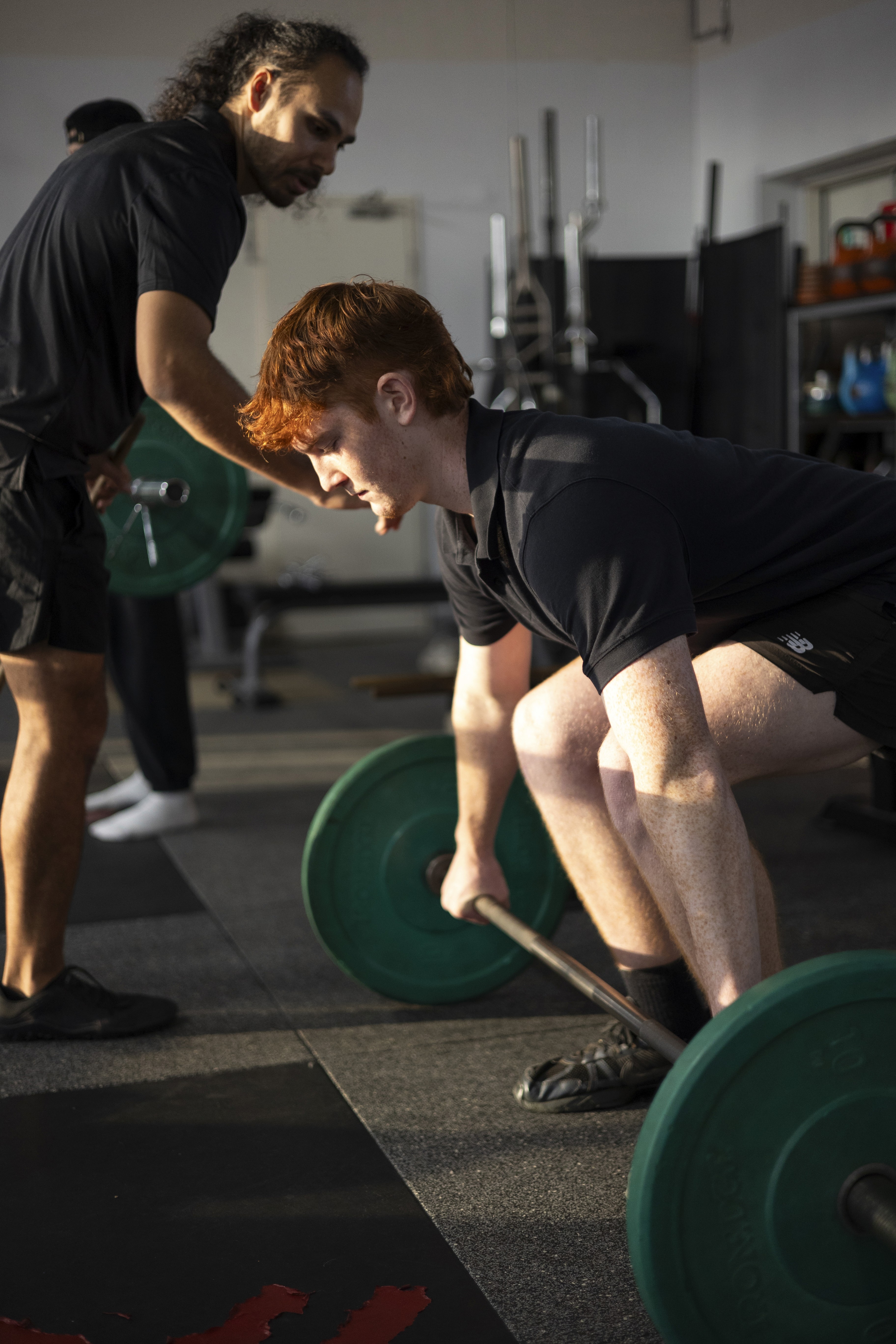
Start with an honest assessment. Not where your body was, where it is today. At The Richmond Gym that means a movement screen: an objective look at how you squat, hinge, push and pull, and where old restrictions or side-to-side asymmetries are hiding. After years away from training, usually paired with a desk job, the patterns are predictable, stiff hips, a locked-up upper back, and glutes that have quietly forgotten their job. Knowing this before you load up is the difference between building strength and building a problem.
Prioritise movement quality over weight. Your first few weeks back are about re-grooving good patterns under control. Lighter loads, clean technique, full range. The weight will come, and faster than you'd expect, once the movement is sound.
Progress gradually. Add small amounts of load week to week rather than chasing the numbers you used to hit. Slow progression is what lets your tendons and joints keep pace with your muscles, and it's the surest way to stay injury-free through the crucial first few months.
Focus on the patterns that carry over. Squatting, hinging, pushing, pulling and carrying are the movements that translate directly into real life: stairs, luggage, the garden, keeping up with your kids or grandkids. Build these and everything else gets easier.
Respect recovery. Recovery capacity is one of the things that changes most with age. Two to three well-structured sessions a week, with genuine rest between them, is plenty to produce meaningful results, and far more sustainable than five sessions that leave you wrecked and demotivated by week two. Research on training frequency shows that meaningful strength gains can be achieved across a range of weekly frequencies once total effort is accounted for (Grgic et al., 2018).
What realistic progress looks like
In your first month back, expect to feel your coordination and control return quickly, the nervous system adapts fast. Noticeable strength gains typically follow through months two and three, with visible changes to body composition arriving a little later. The men who succeed are rarely the ones who train hardest in week one. They're the ones still training consistently in month six. Patience early is what buys you results that last.
You don't have to figure it out alone
The reason our 3-Week Strength for Life program exists is precisely because starting again is the hardest part. It's built for men who want to move without pain and rebuild real capacity, in a room full of people their own age, coached by people who understand that a 50-year-old body needs a different approach to a 25-year-old one.
You get a 3D movement screen to find the root cause of any stiffness or pain, private coaching sessions to rebuild strength safely around your body, and a clear, structured path back into training. No ego. No meatheads. No guesswork.
The best time to start was years ago. The second-best time is this week.
Claim your spot in Strength for Life. Over $600 in value. Richmond VIC. Limited spots.
References
Cruz-Jentoft, A. J., & Sayer, A. A. (2019). Sarcopenia. The Lancet, 393(10191), 2636-2646. https://doi.org/10.1016/S0140-6736(19)31138-9
Grgic, J., Garofolini, A., Orazem, J., Sabol, F., Schoenfeld, B. J., & Pedisic, Z. (2020). Effects of resistance training on muscle size and strength in very elderly adults: A systematic review and meta-analysis of randomized controlled trials. Sports Medicine, 50(11), 1983-1999. https://doi.org/10.1007/s40279-020-01331-7
Grgic, J., Schoenfeld, B. J., Davies, T. B., Lazinica, B., Krieger, J. W., & Pedisic, Z. (2018). Effect of resistance training frequency on gains in muscular strength: A systematic review and meta-analysis. Sports Medicine, 48(5), 1207-1220. https://doi.org/10.1007/s40279-018-0872-x
Svensson, R. B., Heinemeier, K. M., Couppe, C., Kjaer, M., & Magnusson, S. P. (2016). Effect of aging and exercise on the tendon. Journal of Applied Physiology, 121(6), 1237-1246. https://doi.org/10.1152/japplphysiol.00328.2016