The Richmond Blog
Fitness Tips, Nutrition Advice & Member Stories
Stay inspired and informed with the latest articles from our fitness experts and community.
Apr 20, 2025
Fitness Tips
Strongman Training for Everyday Life: Why Lifting, Carrying and Pushing Heavy Things Makes You Stronger Where It Counts
Think about the heaviest things you actually lift in a normal week. It's probably not a perfectly balanced barbell. It's the week's shopping from the car to the kitchen, a suitcase up a flight of stairs, a bag of mulch across the backyard, or a teenager who still thinks piggybacks are a good idea. Real life is lopsided, awkward and on the move. That's exactly why strongman-style training is one of the most practical ways to build strength that shows up outside the gym.
What Is Strongman Training?
Strongman is a strength sport built around moving heavy, awkward objects: carrying them, pushing them, pulling them, lifting them from the floor and pressing them overhead. You don't need to be lifting Atlas stones or pulling trucks to get the benefits. Scaled down and properly coached, the same movement patterns (loaded carries, sled pushes and drags, sandbag and odd-object lifts) are some of the most useful tools for everyday people who want to stay capable as they age.
The difference from traditional gym training is simple. A barbell squat trains you to move a balanced load up and down in one plane. Strongman training asks your body to stabilise an unbalanced load, often while walking, turning or changing direction. That's what everyday life asks of you, too.
Why Strongman Training Carries Over to Everyday Life
1. It Builds a Grip That Lasts
Carries and odd-object lifts hammer your grip. That matters more than it sounds. The large international PURE study followed almost 140,000 adults across 17 countries and found that lower grip strength was associated with a higher risk of death from all causes and from cardiovascular disease, making it a stronger predictor than systolic blood pressure (Leong et al., 2015). Grip strength is a simple window into your overall strength, and a strong grip is what lets you keep opening jars, carrying bags and hanging on when it counts.
2. It Trains Your Trunk the Way Life Loads It
When you carry something heavy in one hand or bear-hug a sandbag, your trunk muscles have to work hard to keep your spine stable. Research from Professor Stuart McGill's spine biomechanics lab compared several strongman events and found each one created a distinct pattern of trunk muscle activation, with carries in particular demanding high levels of torso stiffness to control the load (McGill et al., 2009). The same study also showed that these events place significant load through the spine. That's why technique, sensible progressions and good coaching matter, and why we never just hand someone a heavy implement and say "go".
3. It Builds Strength That Transfers
Strongman training isn't a gimmick. In a seven-week study comparing strongman training with a traditional resistance training program, both groups made similar improvements in strength, power and performance measures, leading the researchers to conclude that strongman training is an effective alternative to traditional gym training (Winwood et al., 2015). Coaches and researchers have also highlighted strongman implements as a practical way to develop the total-body, multi-directional strength athletes need on the field (Zemke & Wright, 2011). You get the strength benefits of lifting, plus practice at the unbalanced, moving loads you actually meet day to day.
4. It Doubles as Conditioning
Push a sled or carry a heavy load for 30 metres and your heart rate will tell you it's not just a strength exercise. Strongman-style work builds strength and work capacity at the same time, so you're better prepared for the long day of moving house, the weekend in the garden or a full day on the slopes.
5. It's Easy to Scale and Hard to Get Bored Of
A carry can be a pair of light kettlebells or a heavy sandbag. A sled can be pushed empty or loaded up. That makes strongman-style training easy to match to where your body is right now, whether you're returning to training at 50 or you've been lifting for years. And, let's be honest, it's fun. There's something deeply satisfying about picking up something heavy and moving it.
How The Richmond Gym Builds Strongman Elements Into Our Classes
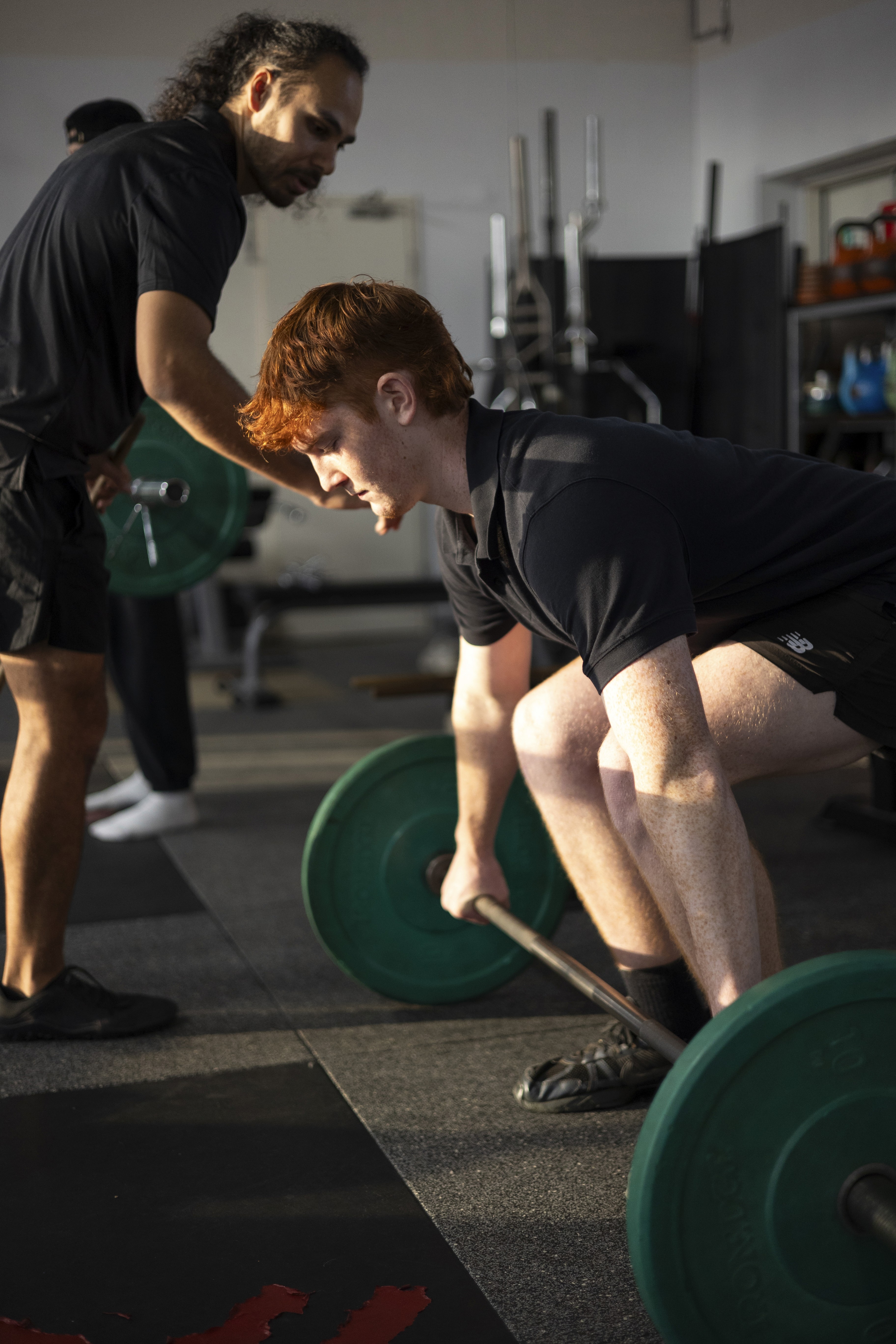
At The Richmond Gym, strongman-style movements are part of how we program our small group classes, not an occasional novelty. Alongside the fundamental lifts, your sessions include elements like loaded carries, pushing and pulling heavy implements, and lifting awkward objects, all coached with the same attention to technique we bring to a squat or deadlift.
Because every member starts with a movement screen, we know how to scale these movements for your body, your training history and any old injuries you're managing. With small classes and experienced coaches, you get the practical, real-world strength that strongman training builds, without the guesswork or the unnecessary risk.
Start With Our 3-Week Strength for Life Program
If you want to feel strong carrying the shopping, lifting the kids, moving furniture or getting through a big day on the mountain, our 3-Week Strength for Life program is the place to start. It's designed for adults who want to build real strength safely, with a coach guiding you through the foundational lifts and the strongman-style movements that make everyday life easier.
Ready to build strength that works outside the gym? Start your 3-Week Strength for Life program and feel the difference in everything you lift, carry and push.
References
Leong DP, Teo KK, Rangarajan S, et al. Prognostic value of grip strength: findings from the Prospective Urban Rural Epidemiology (PURE) study. The Lancet. 2015;386(9990):266-273.
McGill SM, McDermott A, Fenwick CM. Comparison of different strongman events: trunk muscle activation and lumbar spine motion, load, and stiffness. Journal of Strength and Conditioning Research. 2009;23(4):1148-1161.
Winwood PW, Cronin JB, Posthumus LR, Finlayson SJ, Gill ND, Keogh JWL. Strongman vs. traditional resistance training effects on muscular function and performance. Journal of Strength and Conditioning Research. 2015;29(2):429-439.
Zemke B, Wright G. The use of strongman type implements and training to increase sport performance in collegiate athletes. Strength and Conditioning Journal. 2011;33(4):1-7.